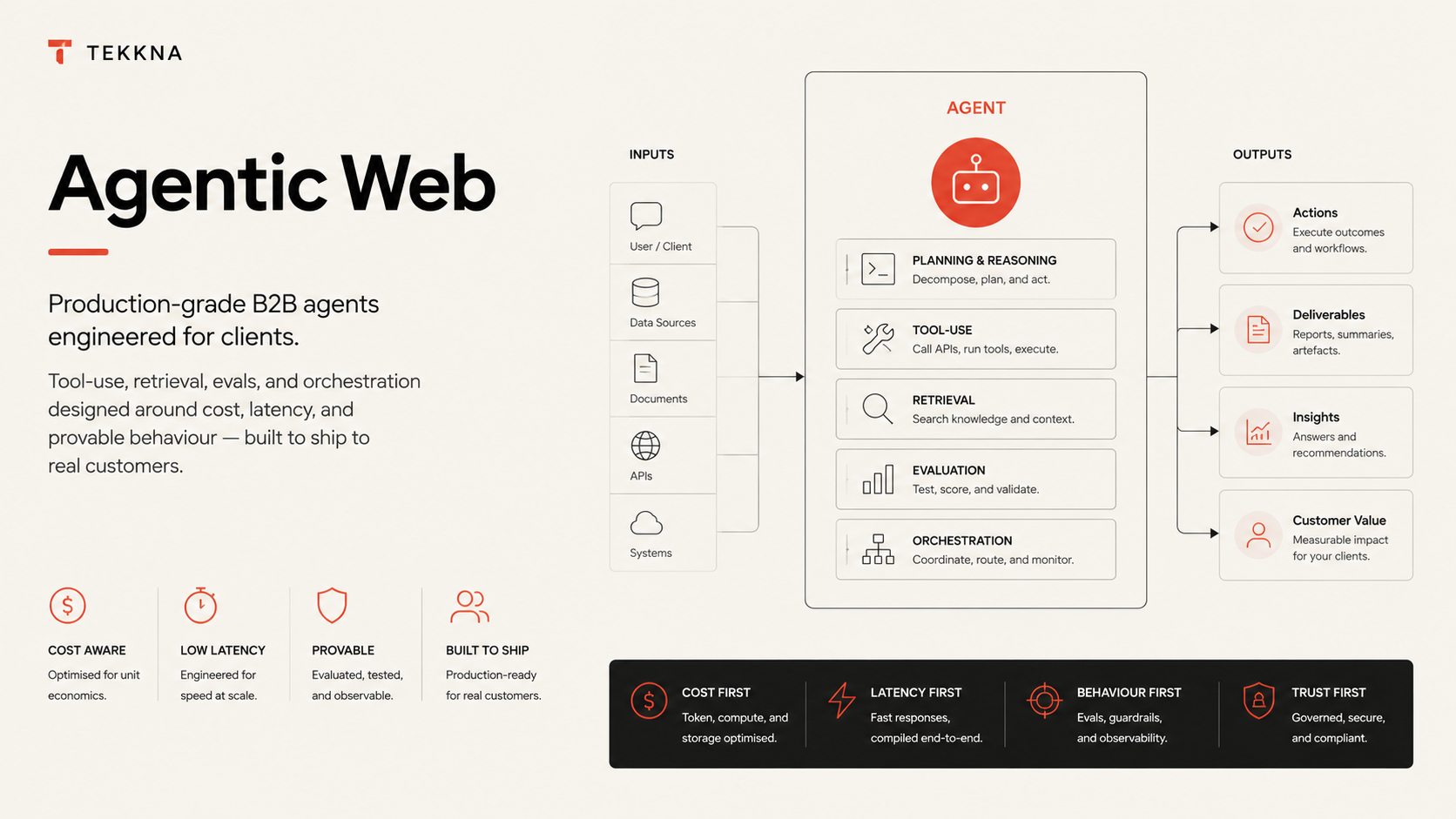
Most agentic AI demos break the second they meet a real workflow. The difference between a demo and a production system is mostly retrieval, evals, and the boring loop around the model.
There’s a particular kind of deck the AI hype cycle produces. An agent navigates a website autonomously. An agent files an expense. An agent books a flight. Demo applause, polite questions, slides forwarded. Then nothing ships, because what shipped wasn’t an agent — it was a demo.
What changes between demo and production
The model is the same. The leverage isn’t there.
Real workflows are made of corner cases. A user message that’s actually two questions. A KB article three months out of date. A policy line that says “always escalate this kind of case to a human” buried in a 40-page document the agent should have read. These don’t show up in demos because demos are designed to dodge them. They show up everywhere in production.
The teams that ship agentic systems don’t have a better model. They have a better loop around the model:
- Retrieval that grounds every response. Citations into source documents, citations that are auditable, citations the agent can’t silently ignore.
- Evals on every change. A test suite of real conversations the agent has to keep passing. Performance regression is what kills agents in production.
- A confidence threshold for auto-action. Below it, draft for human review. Above it, ship. Calibrate over time.
- An escalation path that arrives with context. When the agent can’t or shouldn’t act, the human gets a one-paragraph summary, not the raw thread.
Where the real leverage is
Customer support. Sales operations. Onboarding flows. Internal IT triage. Document review for compliance.
Not “build an agent that does X.” Build an agent that handles 80% of X so the humans who handle the remaining 20% are spending all their time on the cases that need a human. That’s where the economics work and the customer experience improves at the same time.
Why most teams build the wrong thing
The wrong instinct is to build a chatbot. A chatbot is an interface, not a system. It moves the existing problem onto a worse channel — now your customers are typing into a box instead of a form.
The right instinct is to build an agent that operates the workflow. The customer isn’t talking to it; the customer is filing a ticket, clicking a button, asking a colleague — and the agent handles whatever happens next. The agent’s interface is the existing system. Customers don’t have to learn anything.
How to start
Pick a workflow that:
- Has clear inputs and clear outputs (you can write the eval).
- Has a measurable success metric (CSAT, resolution time, deflection rate).
- Has volume (so the agent can learn quickly and impact is visible).
- Is currently bottlenecked on human time, not human judgment.
That last one is the most important. Agentic AI is not going to replace decisions that require human discretion. It’s going to remove the time tax around them.