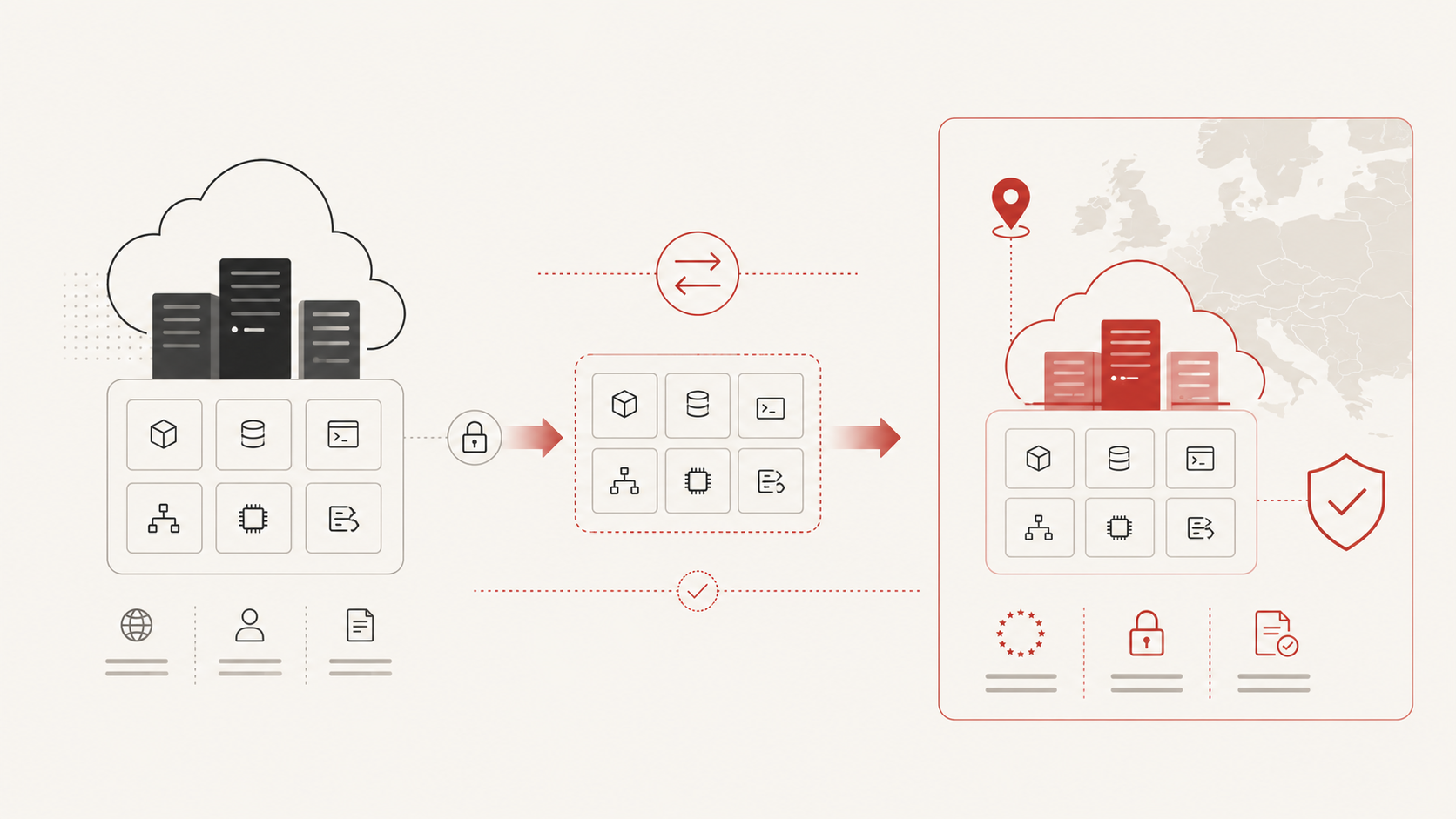
Schrems II didn’t get repealed. The CLOUD Act didn’t get rescinded. And procurement teams in the EU are starting to act on it — quietly, then suddenly.
For five years the European tech community has been talking about cloud sovereignty as a future problem. In 2026 the conversation has shifted: it’s a procurement problem, and it’s now.
The three forces converging
Three dynamics have stopped being abstract:
- Schrems II remains unresolved. The CJEU invalidated Privacy Shield in 2020 and Standard Contractual Clauses alone don’t close the gap. Six years on, no replacement framework produces the legal certainty enterprises need.
- The US CLOUD Act is global by design. US-headquartered providers can be compelled to disclose customer data regardless of where the servers physically sit. “Hosted in Frankfurt” is not the same as “subject to EU law.”
- The EU Data Act forces switching. Cloud providers now have to make migration to alternatives both technically possible and economically reasonable. Egress fees that locked customers in are being unwound.
What it looks like for B2B SaaS
The teams we work with usually arrive with a similar question: how do we stay productive on AWS today while building an EU-resident option for the customers who’ll start asking for it next quarter?
The answer is rarely lift-and-shift everything. Most workloads can be staged:
- Control plane first. Identity, billing, observability — anything that touches every tenant — moves to an EU-resident provider while compute stays where it is.
- Data plane by tier. Tenants who require EU residency get a dedicated EU region; everyone else stays on the existing one. Same code, same deploy pipeline, two destinations.
- Convert opportunistically. New customers go to EU by default. Existing customers convert when contracts come up or when their procurement starts asking.
The provider landscape is finally serious
Five years ago “European cloud” meant compromising on the developer experience. That’s no longer true. Scaleway, Hetzner, OVHcloud, IONOS, STACKIT — each has matured into a viable target for production B2B workloads. The gap to the hyperscalers is real but small, and it shrinks every quarter.
How to start
If you’re considering this, the first step isn’t a Terraform refactor. It’s a two-week audit: catalogue every dependency, every region, every data flow. Produce a target-state diagram and a phased migration plan with costs. The migration is the easier part. Knowing what you have is the harder one.
Migration off the US hyperscalers isn’t an ideological choice. For most B2B SaaS companies selling to European enterprise customers in 2026, it’s the option that loses fewer deals.